

Bringing you the latest news on agriculture
Provided by AGP
Agriculture Equipment Market to Hit USD 264.6 Billion by 2034 on Mechanization Surge and Precision Farming Adoption
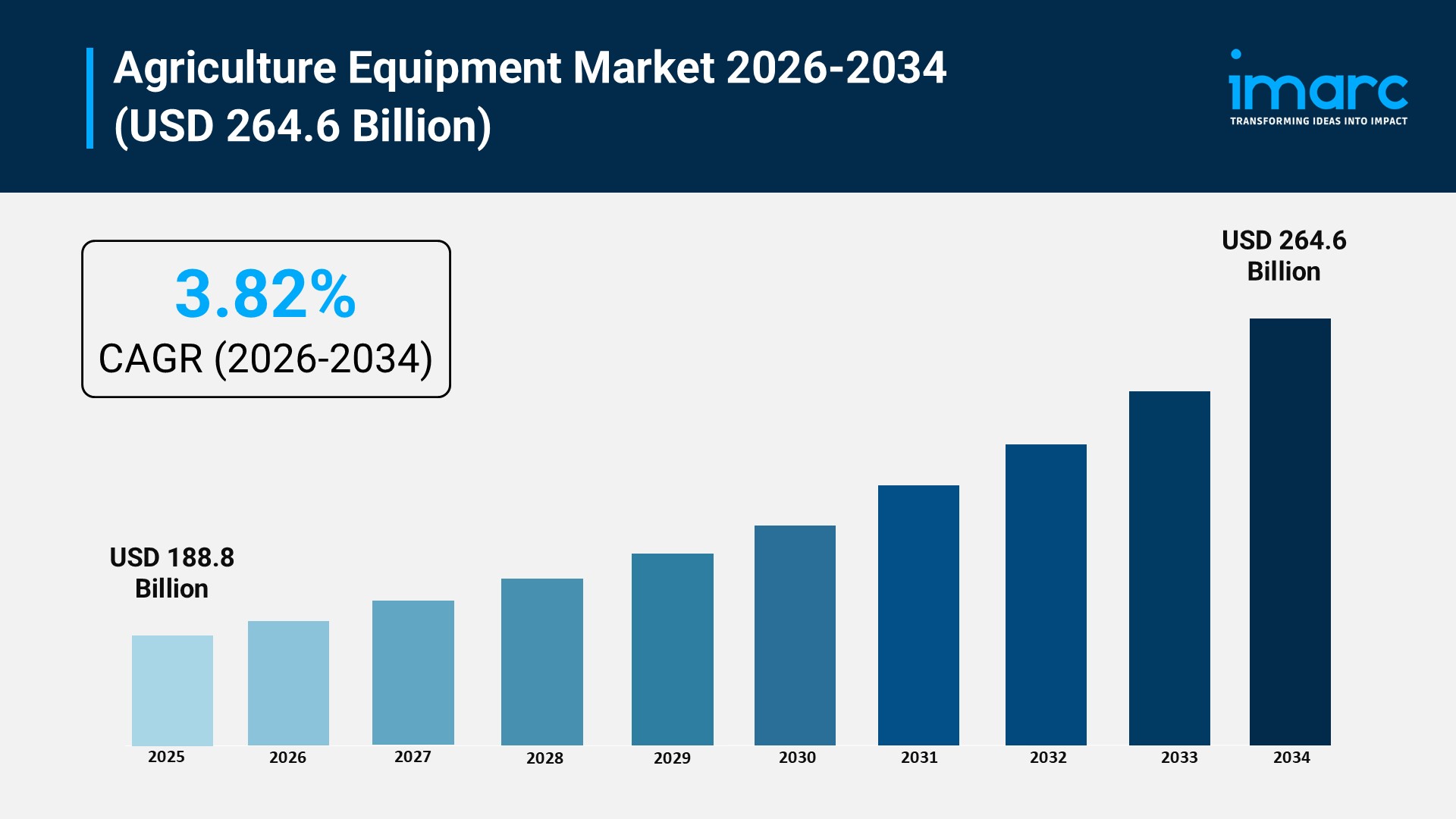
Agriculture Equipment Market Graph 2026
IMARC Group's Latest Research Reveals a CAGR of 3.82% from 2026–2034, with Agriculture Tractor and Land Development Segments Leading Expansion
SHERIDAN, WY, UNITED STATES, May 11, 2026 /EINPresswire.com/ -- The global agriculture equipment market is entering a sustained growth cycle, valued at USD 188.8 Billion in 2025 and projected to reach USD 264.6 Billion by 2034, registering a CAGR of 3.82% between 2026 and 2034, according to the latest research from IMARC Group. The expansion is being driven by rising mechanization, mounting global food demand, and the rapid integration of autonomous tractors, drones, and AI-powered robotics into mainstream farming operations.The scale of the opportunity is underscored by the structural shift in labor availability shaping farm economics. In India alone, agricultural sector employment dropped from 158.2 million in 2022 to 147.9 million in 2023, with the Indian Council of Food and Agriculture projecting a 25.7% decline in the percentage of agricultural workers by 2050, a trend forcing producers across continents to substitute capital equipment for shrinking, costlier human labor.
Request for a sample to get detailed understanding about the market: https://www.imarcgroup.com/agriculture-equipment-market/requestsample
What is Driving Agriculture Equipment Market's Boom?
The report identifies three core forces reshaping the agriculture equipment landscape:
• Low Availability of Skilled Labor: Declining arable land acreage, rural-to-urban migration, and shrinking domestic farm workforces in North America and Europe have created acute dependency on seasonal immigrant labor, driving up wage costs. As reported by the Centre for Monitoring Indian Economy (CMIE), India's agriculture workforce contracted by more than 10 million between 2022 and 2023, pushing farmers toward cost-effective mechanized alternatives.
• Emergence of Precision Agriculture: GPS-guided tractors, drones, and sensors for monitoring soil health, moisture, and crop conditions are accelerating adoption rates worldwide. In October 2023, Deere & Co. partnered with Sweden-based Delaval on the Milk Sustainability Center and Norway-based Yara to develop digital tools that help farmers monitor livestock and fertilizer data for smarter, eco-friendly decisions.
• Mechanization of Farms: Tractors, harvesters, and cultivation equipment underpin sustainable agriculture, yet mechanization gaps remain large in developing economies. A 2022 PRS India report shows 47% of agricultural operations in India were mechanized, compared with 60% in China and 75% in Brazil, signaling significant headroom for equipment manufacturers in emerging regions.
Key Market Insights at a Glance
The following highlights the leading segments by category based on 2025 market share data:
• Equipment Type - Agriculture Tractor: 35.9% market share, anchored by its role as the backbone of modern farming and a steady pipeline of technologically advanced launches.
• Application - Land Development: 26.7% market share, supported by global agricultural land covering 4,781 million hectares and rising demand for soil preparation machinery.
• Sales Channel - Original Equipment Manufacturers (OEM): Leading position driven by superior quality, reliability, warranties, and strong dealer networks.
• Region - Asia Pacific: 36.8% market share in 2025, propelled by rising mechanization, government subsidies, and population-driven food demand.
• Country - United States: 77.80% share of the North America agriculture equipment market in 2024, supported by precision farming and government policy.
Detailed Segment Analysis
1. By Equipment Type: Agriculture Tractor Dominates with 35.9% Share
Agriculture tractors lead the equipment type segment with a 35.9% share of the global market, serving as the foundational machine across virtually every farming activity. Their versatility across tillage, transport, planting, and haulage makes them indispensable for farms of every scale, while the steady rollout of higher-horsepower, telematics-enabled, and electric variants continues to refresh demand. Manufacturers are racing to differentiate on torque, fuel efficiency, and digital connectivity to win over increasingly tech-aware buyers in both developed and emerging markets.
The sub-segment is being actively reshaped by product innovation. In June 2023, Mahindra & Mahindra Ltd launched India's Sarpanch Plus Tractor series, offering higher maximum torque, a 2 HP (1.49 kW) increase in power, and back-up torque designed to cover more ground faster. Sonalika Tractors followed with the Tiger Electric, a field-ready electric tractor for the domestic market, signaling that electrification is moving from concept to commercial deployment. Other categories in the segmentation include harvesting equipment, irrigation and crop processing equipment, agriculture spraying and handling equipment, soil preparation and cultivation equipment, and others.
Connect for detailed segmentation analysis, ask for analyst: https://www.imarcgroup.com/request?type=report&id=6344&flag=C
2. By Application: Land Development Leads at 26.7%
Land development is the largest application segment with a 26.7% share, reflecting its critical role in preparing soil for cultivation, leveling fields, and improving overall agricultural efficiency. According to the Food and Agriculture Organization, the total area under agricultural land was 4,781 million hectares globally - more than 33% of the world's available land area, providing a vast addressable base for land preparation machinery. Rising mechanization in emerging economies is further amplifying demand for tractors and tillers used in this stage of the farming cycle.
The remaining application sub-segments include threshing and harvesting, plant protection, and after agro processing. Each represents a discrete operational stage that increasingly demands specialized equipment as farms scale up and chase higher yields. As governments in developing economies subsidize the transition from manual to mechanized soil preparation, land development is expected to remain the structural anchor of equipment demand.
3. By Sales Channel: OEM Commands the Leading Share
Original equipment manufacturers (OEM) hold the largest market share within the sales channel segment, supplying high-quality, reliable machinery and components directly to farmers and agribusinesses. OEMs are responsible for designing and manufacturing equipment that meets stringent quality standards, and because farmers depend on this machinery for daily operations, durability, reliability, and efficiency are non-negotiable purchase criteria. Strong dealer networks, warranty coverage, and customization options further reinforce OEM dominance, particularly among large-scale buyers.
The competitive intensity within the OEM channel is fueling consolidation and partnership activity. Key players are actively pursuing mergers, acquisitions, and joint ventures to expand product portfolios and broaden geographic reach. The other sub-segment in this category is the aftermarket, which continues to play a vital role in servicing the global installed base of agricultural machinery but trails OEMs in new equipment sales.
4. By Region: Asia Pacific Leads with 36.8% Share
Asia Pacific commands a 36.8% share of the global agriculture equipment market in 2025, driven by rising mechanization, government subsidies, and population-led food demand. China is one of the world's leading producers of farming equipment, the National Bureau of Statistics of China reported that the country produced 5,253,595 large and medium-sized tractors in 2022. Japan is confronting growing abandoned farmland and a shrinking farm labor pool, while India is emerging as both a major tractor producer and a leading exporter to global markets.
Regional sub-segments covered include:
• Asia Pacific (36.8% - Largest): Led by China, Japan, India, South Korea, Australia, and Indonesia, with strong tailwinds from mechanization and rural development policy.
• North America (High Growth): Anchored by precision farming adoption - autosteering systems were used by 52% of midsize farms and 70% of large crop-producing farms in 2023, per USDA.
• Europe: Germany, France, and the UK lead a market valued by EU agricultural production of EUR 223.9 Billion (USD 236.81 Billion) in 2023, with strict environmental rules driving low-emission machinery.
• Latin America: Brazil's USD 9.2 billion 2023 allocation for agricultural modernization, plus growing demand in Argentina, Chile, and Mexico, is lifting tractor and harvester sales.
• Middle East and Africa: Roughly 60% of Africa's working population is engaged in agriculture, with South Africa, Kenya, and Egypt accelerating mechanization.
Regional Spotlight: Where Is the Action?
Asia Pacific dominates the global agriculture equipment market with a 36.8% share in 2025, supported by the world's largest farmer base, aggressive government mechanization programs, and a rapid pivot to drones, automatic tractors, and precision farming tools across India, Japan, South Korea, and Australia. India's agricultural output reached USD 50.2 Billion in 2021-22, and strategic tie-ups such as Mahindra & Mahindra's collaboration with SANY are deepening the region's manufacturing capability and innovation pipeline.
• Asia Pacific: 36.8% global share - Anchored by China's tractor production of 5.25 million units in 2022 and India's emergence as a global tractor exporter.
• North America: Dominated by the United States, which accounted for 77.80% of North America's agriculture equipment market in 2024; total U.S. farm expenditures hit USD 481.9 billion in 2023, up 6.5% year-on-year.
• Europe: Germany, France, and the UK lead, with EU agricultural production at EUR 223.9 Billion (USD 236.81 Billion) in 2023 driving precision and low-emission equipment demand.
• Latin America: Brazil leads with a USD 9.2 billion 2023 modernization allocation; regional agricultural exports rose 18.8% in 2022 per the Inter-American Development Bank.
• Middle East and Africa: Mechanization accelerating in South Africa, Kenya, and Egypt, with North Africa prioritizing water management and precision agriculture.
Technology Is Redefining Agriculture Equipment Operations
Technological transformation is the single most powerful re-rating force in the agriculture equipment industry. Autonomous tractors, drones, AI-powered robotics, and GPS-guided machinery are moving from experimental deployments to mainstream operations, with precision agriculture establishing itself as the new baseline for productive farming. USDA data confirms the speed of this shift in the United States - guidance autosteering adoption climbed from single digits in the early 2000s to 52% of midsize farms and 70% of large-scale crop producers by 2023.
The pace of platform innovation is equally striking. In November 2024, John Deere released a major update to its Operations Center - a mobile and web-based management tool that lets farmers track rainfall by field, monitor seeding quality and equipment-driven productivity variation, and analyze historical data to refine crop management. In December 2024, CropX announced integration with CLAAS, allowing CLAAS equipment users to upload machine data into the CropX agronomy platform for sharper insights into field conditions, irrigation, nitrogen leaching, and crop protection.
Manufacturers are also accelerating electrification and connectivity investments. Sonalika's Tiger Electric tractor, Mahindra USA's launch of subcompact 1100 (20-26 hp) and compact 2100 (23-26 hp) tractor models in February 2024 with telematics and USB charging features, and Massey Ferguson's February 2023 launch of the DYNATRACK Series combining smart technology with high power - collectively signal that the next product cycle will be defined by software, data, and clean propulsion as much as by raw horsepower.
Speak to an Analyst: https://www.imarcgroup.com/request?type=report&id=6344&flag=C
Challenges the Industry Must Address
Despite the strong growth outlook, key challenges remain:
• Acute Skilled Labor Shortages: Urbanization is draining rural workforces faster than mechanization can replace them in some regions. India lost more than 10 million agricultural workers between 2022 and 2023, and the projected 25.7% decline in agricultural workers by 2050 will pressure operators to absorb expensive new equipment even where capital availability is limited.
• High Capital Costs and Affordability Gaps: Modern precision equipment, autonomous tractors, and AI-enabled machinery carry steep upfront costs that remain out of reach for many smallholder farmers, particularly in emerging markets where mechanization rates lag - India is still at 47% mechanization versus 75% in Brazil - slowing the pace at which advanced technologies penetrate the largest farmer populations.
• Regulatory and Environmental Compliance Pressures: Strict EU environmental policies are forcing manufacturers to redesign machinery around low-emission and energy-efficient systems, increasing R&D burden. While this favors well-capitalized incumbents like CLAAS and CNH Industrial, it raises barriers for smaller manufacturers and adds cost pressure across the value chain.
About IMARC Group
IMARC Group is a leading global market research company providing data-driven insights and expert consulting services to businesses seeking to achieve their strategic objectives. With a multi-disciplinary team of industry experts, IMARC delivers thorough, reliable market intelligence across sectors including agriculture and agribusiness, agricultural machinery, food and beverages, automotive and heavy equipment, and technology and automation.
Elena Anderson
IMARC Services Private Limited
+1 201-971-6302
email us here
Legal Disclaimer:
EIN Presswire provides this news content "as is" without warranty of any kind. We do not accept any responsibility or liability for the accuracy, content, images, videos, licenses, completeness, legality, or reliability of the information contained in this article. If you have any complaints or copyright issues related to this article, kindly contact the author above.
