
Engineering Outcomes & Sustainability Objectives: Where Natural Fibre Systems Fit Within Modern Infrastructure Delivery
Engineering Outcomes and Sustainability Objectives: Where Natural Fibre Systems Fit Within Modern Infrastructure Delivery

salike logo
Engineering Outcomes & Sustainability Objectives: Where Natural Fibre Systems Fit Within Modern Infrastructure Delivery
BRIGHTON, UNITED KINGDOM, June 2, 2026 /EINPresswire.com/ -- Sustainability is increasingly discussed within infrastructure delivery, yet in practice the most significant environmental outcomes are often achieved not through sustainability programmes themselves, but through thousands of individual engineering decisions made throughout the lifecycle of a project.Material selection, construction methodology, maintenance requirements, ecological impact and whole life performance all influence the environmental footprint of infrastructure. For geotechnical and environmental engineers, these considerations are becoming progressively more important as projects are expected to deliver not only technical performance, but wider environmental value.
Within this context, natural fibre erosion control and restoration systems occupy an increasingly relevant position.
Engineering first
Natural fibre systems should not be specified simply because they are perceived as environmentally preferable. Their use must be justified through engineering requirements, site conditions and project objectives.
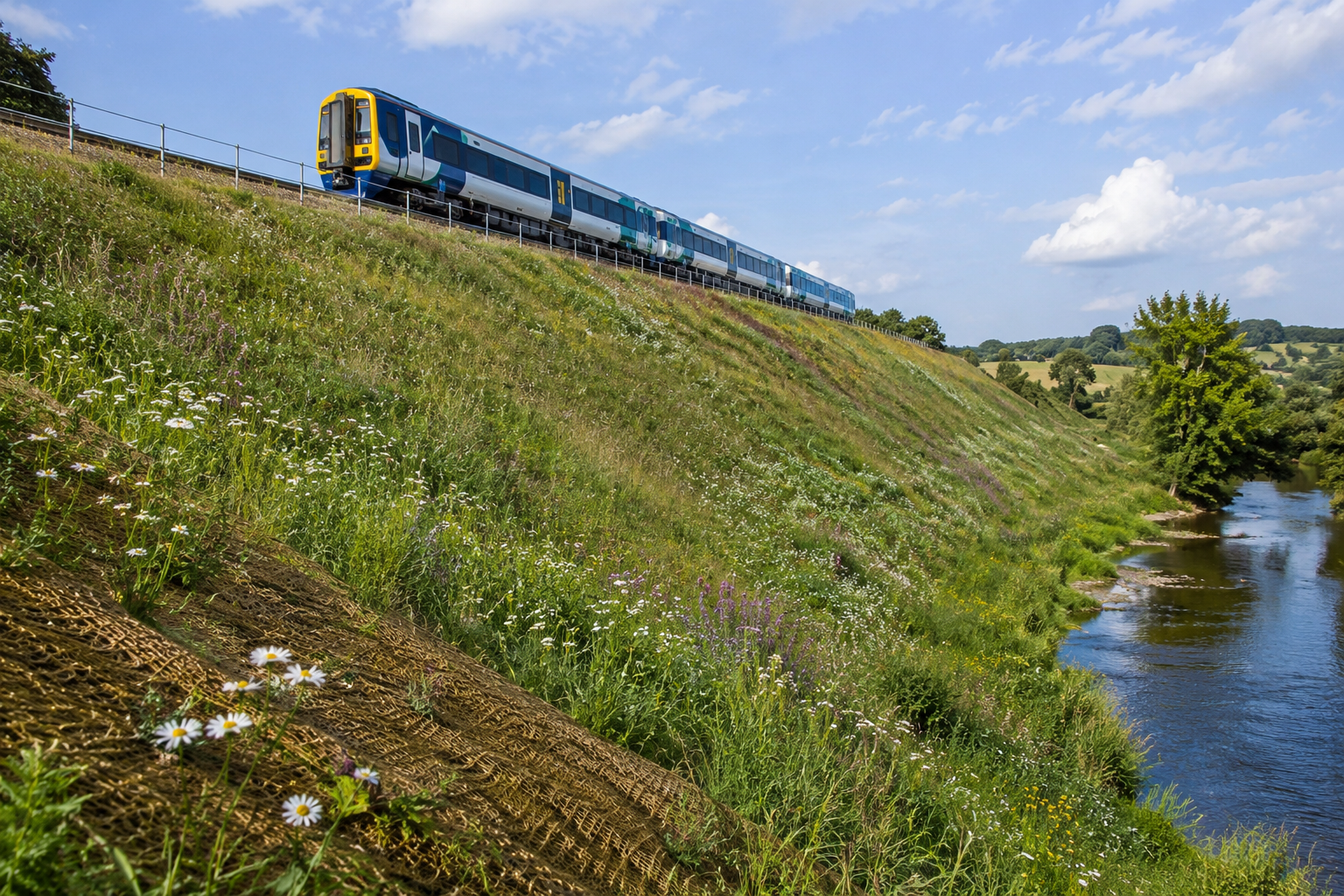
Whether stabilising a riverbank, protecting an exposed slope, establishing vegetation on a newly formed embankment or supporting habitat restoration works, the primary objective remains the same: achieving a durable engineering outcome appropriate to the risks and constraints of the site.
The environmental benefits are most meaningful when they arise from sound engineering judgement rather than becoming the sole driver of specification.
This distinction is important.
Infrastructure projects succeed when environmental performance and engineering performance operate together rather than in competition.
Infrastructure working with natural processes
Historically, many erosion and surface protection challenges were addressed through increasingly rigid interventions. While such approaches continue to play an important role where appropriate, there is growing recognition that certain environments benefit from systems capable of working alongside natural processes rather than attempting to completely constrain them.
Natural fibre geotextiles, coir erosion control systems and vegetated restoration measures support this principle by providing temporary structural support while allowing vegetation to establish and eventually assume a greater stabilising role.
This approach is particularly relevant in river restoration, ecological enhancement schemes, sustainable drainage projects and environmentally sensitive infrastructure corridors where long term resilience often depends upon establishing functioning ecological systems rather than maintaining permanent artificial interventions.
The result is frequently a solution that delivers both engineering stability and environmental enhancement.
Resilience in a changing climate
The engineering profession is increasingly required to consider future climatic conditions rather than relying solely upon historical assumptions.
More intense rainfall events, prolonged wet periods, fluctuating water levels and increasing pressure on drainage infrastructure are becoming common design considerations across many sectors.
In response, there is growing interest in adaptive systems capable of evolving over time.
Natural fibre erosion control products are rarely a complete solution in isolation. However, when incorporated within wider engineering strategies they can contribute to vegetation establishment, surface stability and improved resistance to erosion during critical phases of asset development.
Their value often lies not in replacing traditional engineering measures, but in complementing them.
The most successful projects increasingly combine engineering expertise, ecological understanding and long-term asset management objectives.
Delivering wider environmental value
Many public and private sector projects are now expected to demonstrate broader environmental outcomes alongside technical performance.
These expectations are reflected through biodiversity enhancement initiatives, river restoration programmes, natural flood management strategies and wider commitments to sustainable infrastructure delivery.
Whilst individual products do not deliver these outcomes independently, specification decisions can contribute towards broader project objectives.
Natural fibre systems can support:
Vegetation establishment and habitat creation.
Reduction of sediment migration into watercourses.
Restoration of degraded river corridors.
Integration of engineering works within sensitive landscapes.
Reduced dependence on synthetic materials in suitable applications.
Enhanced compatibility with ecological restoration initiatives.
Such outcomes increasingly align with the wider sustainability aspirations influencing infrastructure procurement and project delivery across the United Kingdom.
Material selection and whole life thinking
Engineering specifications are increasingly informed by whole life considerations rather than initial performance alone.
Questions surrounding durability, maintenance requirements, replacement cycles, environmental impact and eventual end of life treatment are becoming standard components of project evaluation.
Natural fibre systems offer a different material pathway compared with many conventional alternatives. Their role within a project should be considered as part of a broader assessment of site conditions, design life requirements and environmental objectives.
No single material is appropriate for every application.
However, where natural fibre systems can achieve the required technical performance, they may offer additional environmental benefits that contribute positively to the overall project outcome.
Looking beyond compliance
The most effective infrastructure projects are rarely those designed solely to satisfy minimum requirements.
Increasingly, clients, designers and contractors are seeking approaches that provide lasting value beyond immediate project objectives.
This does not necessarily require more complex solutions. Often it involves selecting materials and systems capable of delivering multiple benefits simultaneously: engineering performance, environmental enhancement, climate resilience and long term landscape integration.
Natural fibre engineering systems represent one example of this broader shift in thinking.
As infrastructure delivery continues to evolve, the distinction between engineering performance and environmental performance is likely to become progressively less defined. The projects that succeed most effectively will be those capable of delivering both.
For organisations working within erosion control, river restoration and ecological engineering, this presents an opportunity not only to protect infrastructure assets, but also to contribute towards more resilient and environmentally responsive landscapes.
Shiran Am
Salike Limited
email us here
Visit us on social media:
LinkedIn
Instagram
Facebook
X
Legal Disclaimer:
EIN Presswire provides this news content "as is" without warranty of any kind. We do not accept any responsibility or liability for the accuracy, content, images, videos, licenses, completeness, legality, or reliability of the information contained in this article. If you have any complaints or copyright issues related to this article, kindly contact the author above.
