

Coco Coir Market to Reach USD 1.2 Billion by 2035 as Sustainable Growing Media Gains Global Adoption
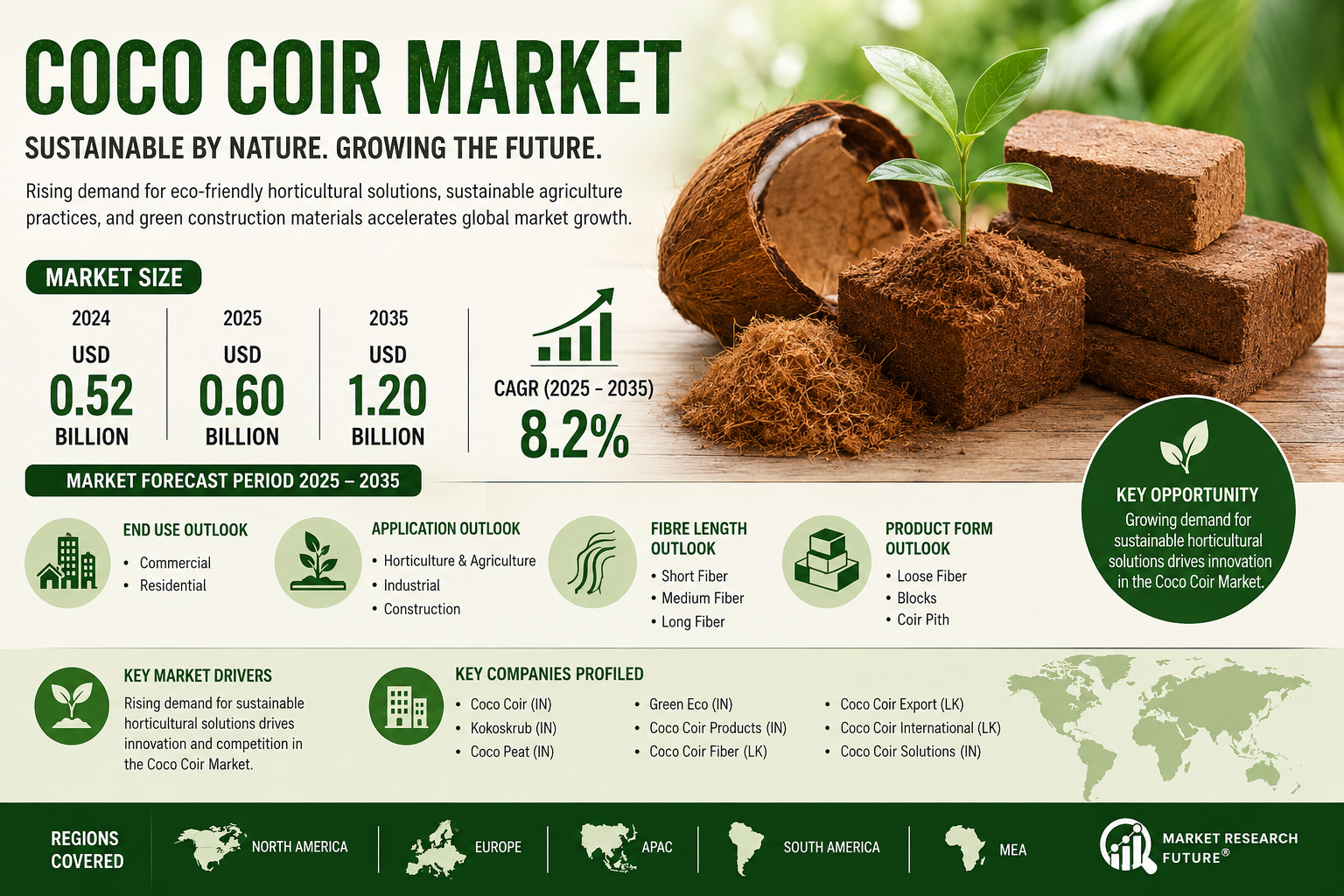
Coco Coir Market
Rising demand for eco-friendly horticultural solutions, sustainable agriculture practices, and green construction materials accelerates global market growth
As sustainable agriculture expands globally, coco coir is emerging as a preferred growing medium due to its renewable nature, water efficiency, and versatility.”
NEW YORK, NY, UNITED STATES, June 25, 2026 /EINPresswire.com/ -- The global Coco Coir Market is poised for significant expansion as industries worldwide increasingly embrace sustainable and environmentally responsible materials. According to the latest research published by Market Research Future, the global Coco Coir Market is expected to grow from USD 0.60 billion in 2025 to USD 1.20 billion by 2035, registering a compound annual growth rate (CAGR) of 8.2% during the forecast period.— Market Research Future (MRFR)
The market was valued at USD 0.52 billion in 2024 and continues to benefit from growing awareness regarding sustainable agricultural practices, increasing demand for organic cultivation methods, and rising adoption of biodegradable materials across multiple industries. Coco coir, a natural fiber extracted from coconut husks, has emerged as a versatile and renewable resource that supports horticulture, agriculture, industrial manufacturing, and construction applications.
As governments, businesses, and consumers place greater emphasis on sustainability, coco coir is increasingly being recognized as an effective alternative to synthetic materials and non-renewable growing media. Its excellent water retention capabilities, aeration properties, biodegradability, and environmental benefits position it as a critical component of the global green economy.
Sustainability Driving Market Transformation
The growing focus on sustainability remains the most influential factor shaping the future of the Coco Coir Market. Across agriculture and horticulture sectors, growers are actively seeking alternatives to traditional peat moss and synthetic growing mediums that have raised environmental concerns over resource depletion and carbon emissions.
Coco coir offers a renewable and environmentally friendly solution because it is derived from coconut processing byproducts that would otherwise be discarded as waste. This circular economy approach aligns with global efforts to reduce waste generation while maximizing resource efficiency.
Consumers are increasingly supporting environmentally responsible products, creating strong incentives for manufacturers and agricultural producers to adopt sustainable raw materials. As a result, coco coir demand continues to rise across commercial greenhouses, urban farming operations, hydroponic facilities, and home gardening applications.
Industry experts believe sustainability-driven purchasing decisions will remain a primary catalyst supporting market expansion throughout the forecast period.
Growing Importance in Modern Agriculture
Agriculture represents one of the largest and fastest-growing application areas within the Coco Coir Market. Farmers and commercial growers are increasingly utilizing coco coir as a soil amendment and growing medium due to its ability to enhance root development, improve moisture retention, and support healthy plant growth.
Unlike conventional soil-based cultivation, coco coir provides a consistent growing environment that helps optimize nutrient delivery while reducing water consumption. These advantages are particularly valuable in regions facing water scarcity challenges and increasing agricultural productivity requirements.
The material's natural resistance to fungal growth and its ability to improve soil aeration further contribute to its popularity among agricultural professionals. Many growers have reported improved crop yields, healthier root systems, and more efficient irrigation practices when utilizing coco coir products.
The growing adoption of controlled-environment agriculture, greenhouse cultivation, and precision farming techniques is expected to create substantial opportunities for coco coir suppliers over the coming decade.
Get Full PDF Sample Copy of Report: (Including Full TOC, List of Tables & Figures, Chart) @ https://www.marketresearchfuture.com/sample_request/22972
Horticulture Industry Fuels Product Demand
The horticulture sector continues to serve as a major revenue contributor to the global Coco Coir Market.
Professional nurseries, landscaping companies, greenhouse operators, and horticultural producers are increasingly incorporating coco coir into cultivation systems due to its exceptional growing properties. The material provides an ideal balance between water retention and drainage, helping plants receive adequate moisture without becoming waterlogged.
The global surge in indoor gardening, vertical farming, hydroponics, and urban agriculture has further accelerated demand. Home gardeners are also becoming more familiar with coco coir products as awareness grows regarding sustainable gardening practices and organic cultivation techniques.
As horticultural operations seek higher productivity while minimizing environmental impact, coco coir is expected to remain a preferred growing medium worldwide.
Expansion of Hydroponic and Soilless Cultivation Systems
One of the most promising growth opportunities for the Coco Coir Market lies within hydroponic and soilless cultivation systems.
Hydroponic farming has gained considerable momentum as growers seek methods that maximize space utilization, reduce water consumption, and increase production efficiency. Coco coir serves as an ideal substrate for hydroponic applications because it provides structural support while facilitating nutrient absorption and root development.
Its ability to retain moisture while maintaining excellent oxygen availability makes it particularly valuable for high-value crops, fruits, vegetables, herbs, and ornamental plants.
As global food demand rises and agricultural land availability becomes increasingly constrained, hydroponic systems are expected to expand significantly, creating long-term demand for coco coir-based growing media.
Construction Industry Discovering Sustainable Applications
Beyond agriculture and horticulture, the construction industry is increasingly recognizing the value of coco coir-based materials.
Construction companies are exploring innovative ways to incorporate natural fibers into erosion control systems, insulation products, geotextiles, and environmentally friendly building materials. Coco coir's durability, biodegradability, and natural strength make it suitable for various infrastructure and landscaping applications.
Geotextile products manufactured from coir fibers are widely used for soil stabilization, slope protection, riverbank reinforcement, and erosion management projects. These solutions provide environmental advantages compared to synthetic alternatives while supporting ecological restoration initiatives.
As green building standards become more prevalent globally, demand for sustainable construction materials is expected to contribute to future market growth.
Industrial Applications Continue to Expand
Industrial sectors are also finding new uses for coco coir products across manufacturing and environmental management applications.
Coir fibers are increasingly utilized in automotive components, packaging materials, mattresses, brushes, floor coverings, and filtration systems. Their renewable nature and durability make them attractive alternatives to synthetic fibers in various manufacturing processes.
Growing corporate sustainability initiatives are encouraging manufacturers to reduce dependence on petroleum-based materials and incorporate renewable resources into product development strategies.
This trend is expected to create additional growth opportunities for producers capable of supplying high-quality coco coir products that meet industrial performance requirements.
Product Form Segmentation Highlights Market Diversity
The Coco Coir Market encompasses multiple product formats designed to serve diverse end-user requirements. With the market valued at USD 0.52 billion in 2024 and projected to reach USD 0.60 billion in 2025 before climbing to USD 1.20 billion by 2035, product diversification is becoming increasingly important as demand expands across agriculture, horticulture, construction, and industrial applications.
Loose Fiber
Loose fiber products remain widely utilized across agriculture, industrial manufacturing, erosion control, and landscaping applications. Their flexibility and adaptability allow users to customize solutions based on specific project requirements. Loose fiber is particularly valued in applications where durability, drainage, and structural support are essential, including soil conditioning, mulching, and geotextile reinforcement.
Blocks
Compressed coco coir blocks continue to gain popularity due to their ease of transportation, storage efficiency, and convenient handling characteristics. Upon hydration, these blocks expand significantly, providing growers with high-quality growing media while minimizing shipping costs. This format is especially attractive for commercial growers and export-oriented suppliers because it reduces logistics expenses and improves product consistency.
The increasing popularity of online gardening retail channels has further supported demand for compressed block products. As more consumers and small-scale growers purchase growing media through e-commerce platforms, demand for compact, easy-to-ship coco coir formats is expected to rise steadily.
Coir Pith
Coir pith, often referred to as coco peat, represents one of the fastest-growing product categories. Widely used in horticulture and hydroponics, coir pith offers superior water retention, aeration, and nutrient management capabilities. It is commonly used in seed starting, potting mixes, greenhouse cultivation, and soilless farming systems.
Its compatibility with sustainable cultivation practices makes it particularly attractive for organic farming and greenhouse production environments. Coir pith is also gaining traction among commercial growers seeking peat alternatives that align with environmental sustainability goals and circular economy principles.
Fiber Length Categories Support Diverse Applications
The market is further segmented according to fiber length, reflecting the wide range of coco coir applications.
Short fibers are commonly used in industrial applications, molded products, and soil conditioning solutions. They are often incorporated into compressed growing media and blended substrates where fine texture and moisture retention are important.
Medium fibers offer versatility across horticultural and agricultural uses, balancing durability with moisture management capabilities. This segment is widely used in nursery operations, landscaping, and mixed growing media formulations.
Long fibers are especially valuable for geotextiles, erosion control products, ropes, mats, and construction-related applications requiring enhanced tensile strength and durability. Their structural integrity makes them suitable for heavy-duty applications where resilience and biodegradability are both required.
As manufacturers continue developing specialized products, fiber-length optimization is expected to play an increasingly important role in product innovation and market differentiation. Product customization based on fiber grade, moisture content, and processing quality is becoming a key competitive factor in both domestic and export markets.
Commercial End Users Lead Market Revenue
Commercial customers account for a significant share of global market demand.
Large-scale agricultural operations, commercial greenhouses, nurseries, landscaping companies, and industrial manufacturers increasingly rely on coco coir products to support productivity and sustainability objectives. These users often purchase in bulk and require consistent quality, standardized packaging, and reliable supply chains.
These organizations often prioritize environmentally responsible materials that can improve operational efficiency while meeting regulatory requirements and customer expectations. In many cases, coco coir is selected as a substitute for peat-based substrates or synthetic materials, helping commercial buyers reduce environmental impact while maintaining performance.
The growing adoption of sustainable procurement policies across commercial sectors continues to support market expansion. As more businesses integrate ESG goals into sourcing strategies, demand for renewable and biodegradable raw materials such as coco coir is expected to strengthen further.
Residential Demand Continues to Rise
Residential consumers represent an increasingly important growth segment.
Home gardening enthusiasts, urban gardeners, and environmentally conscious homeowners are embracing coco coir products for planting, landscaping, and indoor gardening applications. Growing interest in food self-sufficiency, organic cultivation, and sustainable living practices has further increased household demand.
The expansion of e-commerce gardening platforms has made coco coir products more accessible to consumers worldwide, supporting continued market penetration. Retail packaging formats such as small blocks, ready-to-use mixes, and pre-moistened substrates are helping broaden adoption among first-time gardeners and hobby growers.
Rising participation in balcony gardening, container gardening, and indoor plant care is also contributing to stronger residential demand, particularly in urban areas where space-efficient and low-maintenance growing solutions are preferred.
Regional Outlook
Asia-Pacific remains the dominant region within the global Coco Coir Market due to its significant coconut production capacity and established processing infrastructure. Countries such as India and Sri Lanka serve as major suppliers of coco coir products to international markets. The region benefits from abundant raw material availability, lower production costs, and strong export networks, making it a central hub for global supply.
North America continues to witness growing demand driven by sustainable agriculture initiatives, greenhouse expansion, and increasing adoption of hydroponic cultivation systems. The region is also seeing rising interest in organic gardening and peat alternatives, which is supporting broader use of coco coir in both commercial and residential applications.
Europe is experiencing strong growth as environmental regulations and sustainability objectives encourage the use of renewable materials across agriculture, horticulture, and construction sectors. The region’s emphasis on reducing carbon-intensive inputs and promoting circular economy practices is expected to support continued adoption of coco coir-based products.
South America presents emerging opportunities due to expanding agricultural activities and increasing awareness regarding sustainable cultivation techniques. As commercial farming operations modernize and water-efficient growing solutions gain traction, demand for coco coir is likely to increase across the region.
Meanwhile, the Middle East and Africa are expected to witness gradual adoption as water conservation concerns and agricultural modernization initiatives support demand for efficient growing media solutions. In water-stressed markets, coco coir’s moisture retention and soil-conditioning properties make it especially attractive for greenhouse and controlled-environment agriculture.
Competitive Landscape
The global Coco Coir Market remains moderately fragmented, with companies focusing on production capacity expansion, product innovation, export growth, and sustainability initiatives.
Key market participants include:
• Coco Coir (India)
• Kokoskrub (India)
• Coco Peat (India)
• Green Eco (India)
• Coco Coir Products (India)
• Coco Coir Fiber (Sri Lanka)
• Coco Coir Export (Sri Lanka)
• Coco Coir International (Sri Lanka)
• Coco Coir Solutions (India)
Market participants are investing in advanced processing technologies, quality certification programs, and international distribution networks to strengthen competitive positioning.
Strategic partnerships with greenhouse operators, agricultural distributors, and horticultural suppliers are becoming increasingly important as companies seek to expand market reach and improve customer access.
Future Outlook
The future of the Coco Coir Market remains highly promising as sustainability continues to influence purchasing decisions across industries. Growing awareness regarding environmental protection, resource conservation, and sustainable cultivation practices is expected to support long-term market expansion.
Technological advancements in processing methods, increasing adoption of hydroponic farming systems, and expanding applications in construction and industrial manufacturing are creating new growth avenues for industry participants.
With market revenues projected to reach USD 1.20 billion by 2035, coco coir is positioned to become an increasingly important component of sustainable agriculture and environmentally responsible manufacturing worldwide.
As governments, businesses, and consumers continue prioritizing renewable resources and circular economy solutions, the Coco Coir Market is expected to play a vital role in supporting the transition toward a more sustainable global economy.
Discover Related Research Reports By Market Research Future:
Peat Market
https://www.marketresearchfuture.com/reports/peat-market-1387
Soil Stabilization Market
https://www.marketresearchfuture.com/reports/soil-stabilization-market-6306
AgTech Market
https://www.marketresearchfuture.com/reports/agtech-market-16103
Sagar Kadam
Market Research Future
+1 628-258-0071
email us here
Visit us on social media:
LinkedIn
Facebook
YouTube
X
Legal Disclaimer:
EIN Presswire provides this news content "as is" without warranty of any kind. We do not accept any responsibility or liability for the accuracy, content, images, videos, licenses, completeness, legality, or reliability of the information contained in this article. If you have any complaints or copyright issues related to this article, kindly contact the author above.
