

Phase Change Material Market to Hit $4.51 Billion by 2035 at 16.4% CAGR
Phase Change Material Market
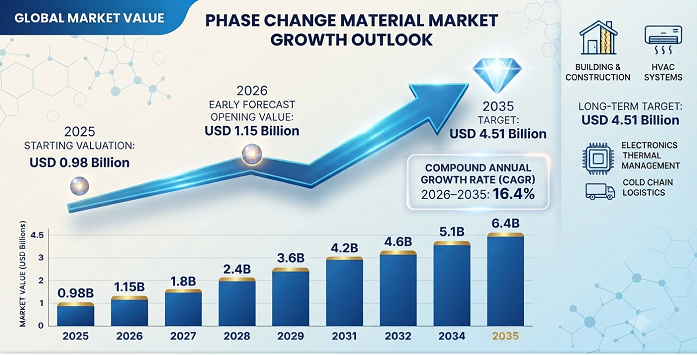
According to the latest Market Research Future analysis, the global Phase Change Materials Market was valued at approximately USD 0.98 billion in 2025. The market is projected to reach USD 4.51 billion by 2035, expanding at a 16.4% CAGR between 2026 and 2035.
What Are Phase Change Materials?
Phase change materials are specialized substances capable of storing and releasing thermal energy during a phase transition. Unlike conventional materials that primarily store sensible heat by changing temperature, PCMs can store large quantities of latent heat within a relatively narrow temperature range.
This characteristic makes them valuable for applications where maintaining a stable temperature is important. PCMs can help reduce temperature fluctuations, shift energy consumption away from peak periods, improve thermal comfort, and support more efficient cooling and heating systems.
Common PCM categories include organic materials, inorganic materials, bio-based materials, and eutectic mixtures. Paraffins, salt hydrates, fatty acids, esters, and sugar alcohols are among the chemical compositions used in PCM technologies.
Phase Change Materials Market Growth
The market is being driven by increasing demand for energy-efficient technologies and the growing need to manage thermal energy more effectively.
Buildings represent one of the largest opportunities. PCM-based components can be incorporated into walls, ceilings, floors, insulation systems, and other parts of building envelopes to absorb excess heat and release it when temperatures fall.
The building and construction sector accounted for 36.4% of the PCM market in 2025, according to the report. Growing energy-efficiency requirements and the increasing adoption of sustainable building technologies are expected to support further demand.
The market is also benefiting from the rapid expansion of electric vehicles, cold-chain logistics, pharmaceuticals, and data centers, where effective thermal management is becoming increasingly important.
Get Sample @ https://www.marketresearchfuture.com/sample_request/8282
Key Trends in the Phase Change Materials Market
1. Growing Demand for Energy Efficiency
Energy costs and sustainability requirements are encouraging businesses and building owners to adopt technologies that can reduce heating and cooling requirements.
PCMs can store thermal energy during periods of excess heat or lower energy costs and release it when needed. This capability can help reduce peak cooling loads and improve overall energy management.
Increasingly stringent building-energy standards in Europe and North America are also supporting the adoption of thermal-storage technologies.
2. Expansion of Electric Vehicle Applications
Electric vehicle battery packs generate heat during charging, discharging, and high-performance operation. Maintaining batteries within an appropriate temperature range is important for performance, safety, and durability.
PCM-based thermal management systems can absorb heat generated during temperature peaks and help prevent rapid temperature increases.
The report estimates that EV battery-pack applications are growing at approximately 18.2% annually, making electric mobility one of the most attractive emerging applications for phase change materials.
3. Cold Chain and Pharmaceutical Applications
Temperature-sensitive pharmaceuticals, vaccines, biologics, food products, and other products require controlled transportation and storage.
PCM-based packaging can maintain specified temperature ranges for extended periods without relying exclusively on active refrigeration or dry ice. This makes PCMs particularly attractive for pharmaceutical logistics and temperature-controlled food distribution.
Cold-chain logistics and pharmaceutical shipping generated approximately USD 0.19 billion in PCM revenue in 2025, according to the Market Research Future report.
4. Increasing Use in Data Centers
The rapid growth of cloud computing, artificial intelligence, and high-performance computing is increasing the thermal load of data centers.
Conventional cooling infrastructure can require substantial amounts of electricity. PCM-based thermal buffers can provide additional thermal storage capacity and help manage short-duration peaks in cooling demand.
As data-center operators focus increasingly on energy efficiency, reliability, and demand management, PCM technology could become a valuable component of advanced thermal-management systems.
5. Growth of Bio-Based Phase Change Materials
Sustainability is encouraging manufacturers to develop phase change materials from renewable or bio-based feedstocks.
Bio-based PCMs can be produced using materials such as fatty acids, plant-derived oils, agricultural residues, and other renewable resources.
According to the report, bio-based products are projected to grow at approximately 17.6% CAGR through 2035, making them the fastest-growing technology-level segment.
Phase Change Materials Market Segmentation
The market can be analyzed across product type, chemical composition, encapsulation technology, end-user industry, and geography.
By Product Type
The major product categories include:
Organic
Inorganic
Bio-based
Eutectic mixtures
Organic PCMs accounted for approximately 40.8% of market revenue in 2025. Their established supply chains and predictable melting characteristics have supported their widespread adoption.
Bio-based materials, however, are expected to experience particularly strong growth as sustainability becomes a more important purchasing consideration.
By Chemical Composition
Major chemical categories include:
Paraffin
Salt hydrates
Fatty acids and esters
Sugar alcohols
Other specialized formulations
Paraffin-based materials remain important because of their established commercial availability and predictable phase-transition behavior. Salt hydrates are attractive because of their high volumetric thermal-storage potential, although challenges such as supercooling and phase separation remain areas of research.
By Encapsulation Technology
PCM systems can use different encapsulation approaches, including:
Macro-encapsulation
Micro-encapsulation
Nano-encapsulation
Shape-stabilized composites
Macro-encapsulation accounted for approximately USD 0.59 billion in revenue in 2025, supported by applications in construction and cold storage.
Encapsulation is particularly important because it helps control the PCM during phase transitions and can improve durability, handling, and integration into commercial products.
Buy Now @ https://www.marketresearchfuture.com/checkout?currency=one_user-USD&report_id=8282
Regional Market Outlook
Europe currently represents the largest regional market, accounting for approximately 30.2% of global revenue in 2025. Strong building-energy regulations and the region's focus on reducing carbon emissions are supporting demand for thermal-energy management technologies.
North America holds the second-largest position, with approximately 28.6% of the market. Demand in the region is supported by energy-efficiency investments, data-center cooling requirements, utility demand-response opportunities, and advanced building technologies.
Asia-Pacific is expected to be the fastest-growing regional market, with a projected 17.3% CAGR through 2035. China, India, and South Korea are becoming increasingly important due to industrial development, electric vehicle production, electronics manufacturing, construction activity, and investments in thermal-management technologies.
The Middle East and Africa also present emerging opportunities, particularly through district cooling, infrastructure development, and energy-efficiency projects.
Key Companies in the Phase Change Materials Market
The competitive landscape includes companies involved in PCM formulation, thermal-management products, encapsulation technologies, and specialized applications.
Major companies identified in the Market Research Future report include:
Phase Change Solutions Inc.
Croda International plc
Honeywell International Inc.
BASF SE
Outlast Technologies LLC
Rubitherm Technologies GmbH
These companies are focusing on product development, advanced formulations, encapsulation technologies, sustainability, and expansion into emerging applications.
Major Opportunities in the Market
The PCM industry has several significant growth opportunities.
Smart Buildings
The integration of PCMs with building sensors, automated HVAC systems, and energy-management platforms could create more intelligent thermal-energy systems.
Instead of simply absorbing heat, future PCM installations could respond dynamically to weather conditions, electricity prices, occupancy, and grid requirements.
Emerging Markets
India, Southeast Asia, and the Gulf region represent significant opportunities because of expanding construction activity and rising cooling demand.
Local manufacturing and encapsulation capacity could reduce transportation costs and make PCM solutions more competitive in these markets.
Grid-Interactive Buildings
PCM-based thermal storage can potentially contribute to demand response by allowing buildings to reduce cooling or heating demand during periods of electricity-system stress.
This creates an opportunity for PCMs to become part of broader grid-interactive building systems and energy-management platforms.
Pharmaceutical Logistics
The growth of biologics, vaccines, cell and gene therapies, and temperature-sensitive medicines is increasing the need for reliable temperature-controlled transportation.
Reusable PCM-based shipping containers could become increasingly valuable as pharmaceutical supply chains become more sophisticated.
Read More @ https://www.marketresearchfuture.com/reports/phase-change-materials-market-8282
Challenges Facing the PCM Market
Despite strong growth prospects, the industry faces several challenges.
High Initial Cost
PCM systems can have higher upfront costs than conventional thermal-storage approaches. Although they may generate energy savings over their operating life, the initial investment can slow adoption.
Material Stability
Some inorganic PCMs can experience supercooling and phase separation, which can reduce their long-term performance.
Improving cycling stability and ensuring consistent thermal properties remain important priorities for manufacturers.
Flammability and Safety
Certain organic PCMs, particularly paraffin-based materials, can create fire-safety concerns. Encapsulation, additives, and improved formulations are being developed to address these challenges.
Building-code requirements can also increase the cost and time required to qualify PCM products for specific construction applications.
Encapsulation Costs
Encapsulation is an important part of PCM product development, but advanced encapsulation processes can require significant capital investment and sophisticated manufacturing capabilities.
Reducing encapsulation costs while maintaining durability and performance will be critical to achieving broader commercial adoption.
Browse More Reports:
Methyl Isobutyl Ketone Market https://www.marketresearchfuture.com/reports/methyl-isobutyl-ketone-market-4254
Polyarylsulfone Market https://www.marketresearchfuture.com/reports/polyarylsulfone-market-5906
US Rubber market https://www.marketresearchfuture.com/reports/us-rubber-market-18478
france artificial turf market https://www.marketresearchfuture.com/reports/france-artificial-turf-market-47438
US Auto catalyst market https://www.marketresearchfuture.com/reports/us-auto-catalyst-market-15675
us plastics market https://www.marketresearchfuture.com/reports/us-plastics-market-17818
US Powder Coatings market https://www.marketresearchfuture.com/reports/us-powder-coatings-market-20261
Market Research Future
Market Research Future
+1 855-661-4441
email us here
Legal Disclaimer:
EIN Presswire provides this news content "as is" without warranty of any kind. We do not accept any responsibility or liability for the accuracy, content, images, videos, licenses, completeness, legality, or reliability of the information contained in this article. If you have any complaints or copyright issues related to this article, kindly contact the author above.
